

Nine jobs a retailer can hand to an AI agent today
About this series. Four pieces on what AI agents can and cannot automate in retail. Two of the jobs below are systems we build and operate ourselves, and they are marked as such — the rest describe what the technology does reliably today. Where we quote a number, it is measured on our own systems.
Most writing about AI agents explains what an agent is. A retailer deciding whether to spend money needs something different: a list of work that currently costs you people, with an honest note on what each one replaces, what it needs from you first, and how you would prove it works before trusting it.
Here are nine, sorted by how much can go wrong rather than by how impressive they sound.
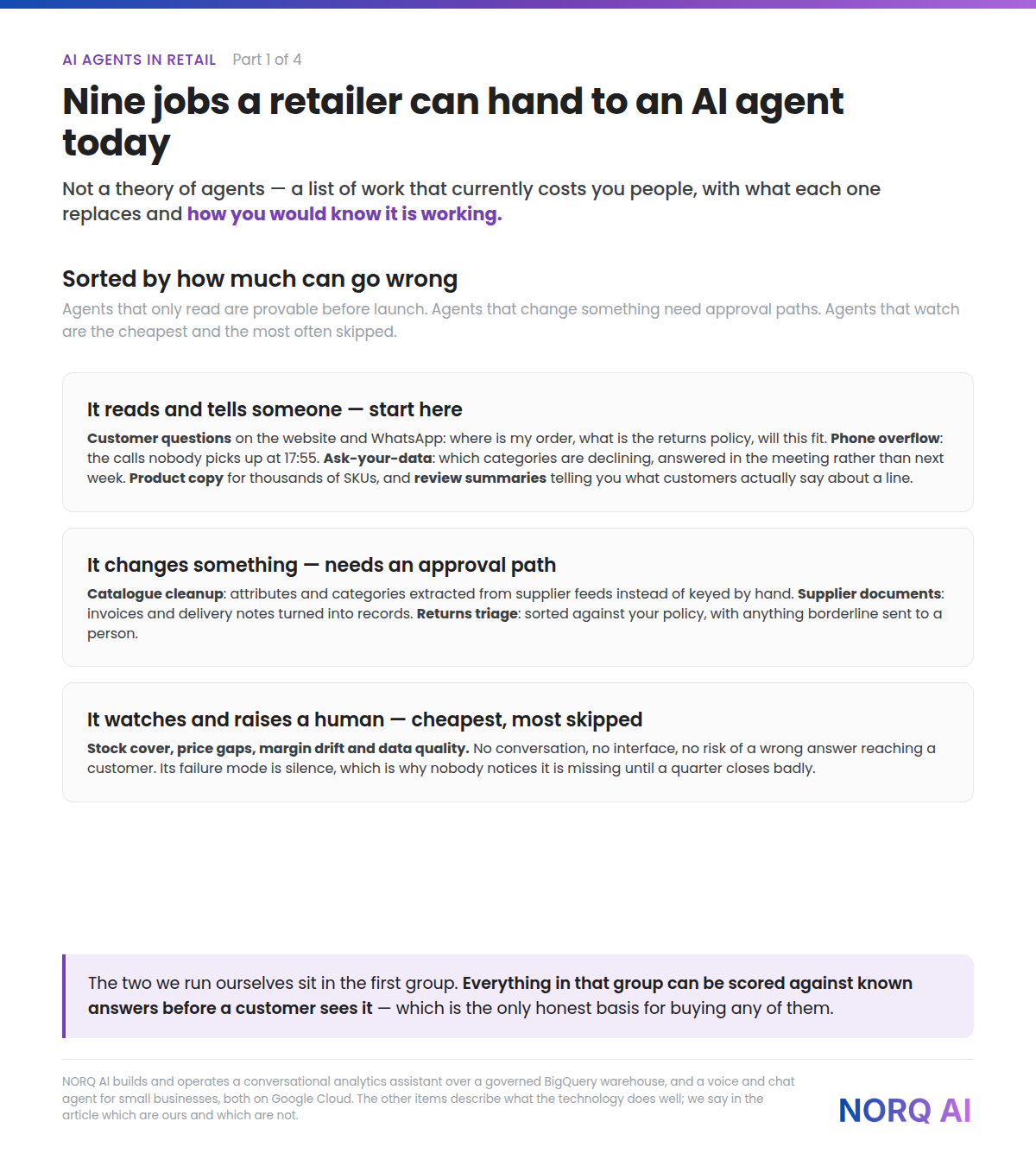
It reads and tells someone
Nothing in your business changes as a result, so the worst case is a wrong answer — and a wrong answer is testable before launch. This is where to spend first.
1. Answering customer questions readswe run this
On the website and on WhatsApp: where is my order, what does the returns policy say, does this run small, do you have it in store.
2. Answering the phone when nobody can readswe run this
The call at 17:55, or while the one person on the shop floor is serving someone. It answers from the same content as the website agent, takes a callback number when it cannot help, and can text a link if the caller agrees out loud.
3. Asking your own data a question readswe run this
“Which categories are declining?” “What share of first-time buyers come back?” Answered in about twenty seconds, with a chart and the query behind every figure.
4. Writing product copy at catalogue scale reads
Descriptions, category pages, size and care notes, translations, variants for each marketplace — drafted from your attributes, published by a person.
5. Telling you what your reviews say reads
What customers actually report about a line, a store or a delivery partner, summarised by theme and tracked over time, instead of a star rating nobody can act on.
It changes something
Now a mistake is an action rather than a sentence, and the architecture has to carry the safety: the agent should pick from options your systems supply, never invent the values. Each of these wants an approval threshold and a reversible path.
6. Cleaning up the catalogue changes
Attributes and categories extracted from messy supplier feeds; duplicates matched; missing fields filled from the product text you already have.
7. Processing supplier documents changes
Invoices, order confirmations and delivery notes read into structured records, with discrepancies against the purchase order flagged to a person.
8. Triaging returns against your policy changes
Reason classified from what the customer wrote, routed to refund, exchange, repair or manual review, with the borderline cases deliberately sent to a person.
It watches and raises a human
9. Watching stock, prices, margin and data quality watches
Stock cover against sales rate, competitor price gaps on your top lines, margin drift by category, and whether the numbers feeding all of it are still correct.
How we would choose between them
| Ask | Why it decides the answer |
|---|---|
| How many times a week does this happen? | Agents earn their keep on volume. A task done twice a month is not worth the governance around it. |
| Is somebody currently waiting? | Work that blocks a person — a queue, an out-of-hours gap, a BI backlog — returns value immediately rather than theoretically. |
| What does a wrong answer cost? | A wrong product description is embarrassing. A wrong refund is money. Price the failure before buying the capability. |
| Can I write down the right answer for fifty cases? | If you cannot, you cannot measure it, and you will be buying on impression. This question disqualifies more projects than any other. |
One pattern worth noticing across all nine: the hard part is rarely the model. It is having your policies written down, your metrics defined, your catalogue coherent and someone named to own the output. That work is reusable — do it for the first agent and the second is dramatically cheaper.
Next in the series: asking your own data a question — the third job above, and what took it from one right answer in ten to nine. All articles.
Start Your Data Transformation Journey
Discover practical, scalable solutions tailored to your business priorities.